
Google Doesn’t Care About Your SEO Content Unless It’s Unique
Take heed. SEO and website marketing is not what it used to be.

My title is an over-simplification, naturally. But it’s also true.
At Google event in Toronto, Canada, Danny Sullivan gave a presentation on the future of SEO and search marketing and showed a slide illustrating the difference between “commodity” and “non-commodity” content.
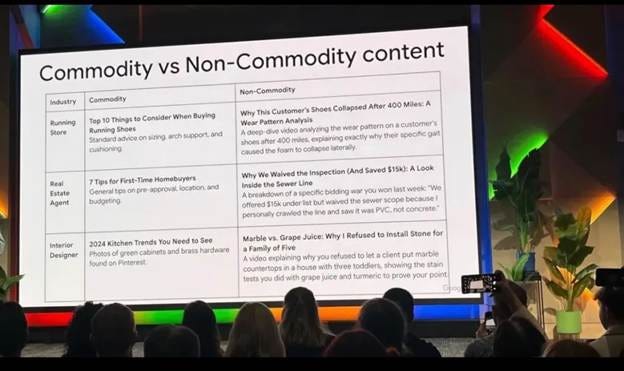
Basically, the Internet is saturated with content that was written to satisfy a business’s SEO goals. That content was used to train large language models, and today’s users are NOT getting their answers directly from the companies that paid to have it written.
I’ve reviewed hundreds of law firm websites over the years, and I know that most of you are writing the same content as the next law firm.
The expectation seems to be that the SEO company can do something to “make it rank.”
Today, Google is telling us that they don’t care about the content most of us write for our websites.
I fear it might be several years before most law firms get the message (millions of dollars will be wasted).
What is Commodity Content?
Commodity content is content that any law firm could write; all that needs to be changed is the name of the author.
This includes:
Listicles (“10 Things You Should Know…”)
“Beginner’s Guides” or how-to articles
“What you should know about…”
…Even practice area pages
I should clarify that commodity content isn’t “bad,” but it’s not valuable to Google.
Let’s be honest, “SEO is dead” became a meme that sounded more like doomerism than reality. But the conversation is more nuanced than “do people still use Google?”
Google still matters. LLM tools matter now, too. So does social media.
But SEO is dead because we’re no longer trying to “hack” our content to get to the top of Google. Google doesn’t care about commodity content because it is/was too easy to replicate. The SEO industry built itself on the back of commodity content and backlinks, and now we’re facing a new reality.
What’s more, Google is telling us they want content that is logistically impossible for an SEO company to create.
Much of what marketers are trained to produce is commodity content. In fact, one of the first unpleasant things I learned about professional marketing is how acceptable (and encouraged) “borrowing” content is.
There was a time when writing was a manual process that involved a real person researching, outlining, writing, and revising. It seemed to me that anyone writing emails, newsletters, and website content was “special” even if their content was partly borrowed or similar to something else.
Now the ability to write low-effort content is no longer a differentiator.
What is Non-Commodity Content?
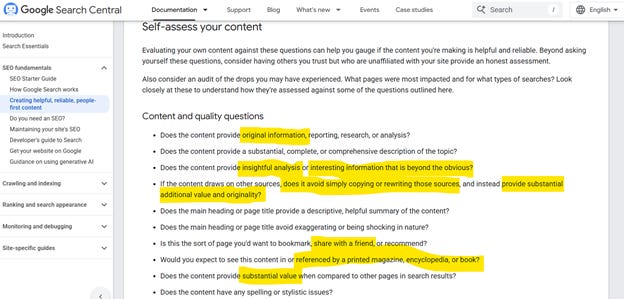
Non-commodity content is unique to the website/business/author. It cannot be “copied and pasted” to another website without committing obvious plagiarism (and possibly actionable copyright infringement).
This includes:
Reviews and testimonials
Articles about your law firm’s recent community efforts
Staff biographies
Case results or case breakdowns
Case studies
Ebooks/books
Stories from your law firm’s team
Partnership content
Basically any video that isn’t AI generated
We can get more specific and start to branch out all the different kinds of content we could make here, but all of this shares one core element:
Non-commodity content requires you to contribute something unique to the Internet.
That’s going to be hard for small law firms that are used to outsourcing their content to vendors.
Here’s the reality of an SEO company. A founder and a small team outsource content writing and backlink acquisition to third-party providers. 90% of your website’s content was written by someone overseas (who is not on the SEO company’s payroll).
SEO companies massively overstate the importance of the content they create. I find it very conspicuous that most SEO companies’ “featured” clients tend to be the ones that do the most community/brand marketing.
Do we need practice area and location pages? 100% yes.
Should those be well-written and comprehensive (even if another law firm could copy them)? Again, yes.
Do you want a well-optimized, user-friendly, and appealing website? Duh, yes.
But does Google care how many FAQs you have? No, they said they don’t.
How Can You Make More Non-Commodity Content at Your Law Firm?
Congratulations, marketer. You are a company journalist now.
And you are the creative director, event planner, documentarian, photographer, and videographer.
Content about your brand (or with unique insights) has more potential to be shared, linked, and recommended than your blog about what to do after a car accident.
I know marketers who spend considerable time writing commoditized blogs and optimizing them in a Sisyphus-like struggle, hoping that Google will notice their efforts.
A simple Google search for the highest value keyword you want to rank for will tell you how much effort is required to truly get to the top.
There’s a general sense that a law firm can find exactly the right type of “long tail” keyword to write and get clients from it. Maybe, but “long tail” implies low volume. Low volume implies… well, not many people will see it.
If you want to get better at making unique content for Google (and social media, but that’s a different article), create these processes at your law firm:
Regular interviews with your staff/attorney
A “case result to website” pipeline
Contributions from your team (photos, case recaps, POVs)
Regularly scheduled community events or contests
Regularly scheduled photoshoots
Regular team events (with photos and video)
Case studies into niche topics related to your practice area
All of these are fairly simple ways you can create content that’s not easily replicated by another law firm.
PLUS… all of these ideas lend themselves to another marketing channel. Videos can be reused on social media, case results can be featured on your homepage, your team can build their personal brands, and you (the attorney) can speak to clients in your REAL voice.
All the stuff I mentioned is significantly harder than writing an FAQ or updating an old article.
None of the stuff I mentioned can be easily outsourced. It requires your data, your team, your face, or something that can’t be ghostwritten or faked.
This is why my general recommendation to law firms is:
Hire a full-time marketer – You need someone full-time to create original content
Hire marketers who can tell stories – You want someone with the ability to weave a compelling narrative from company pictures and law firm case results